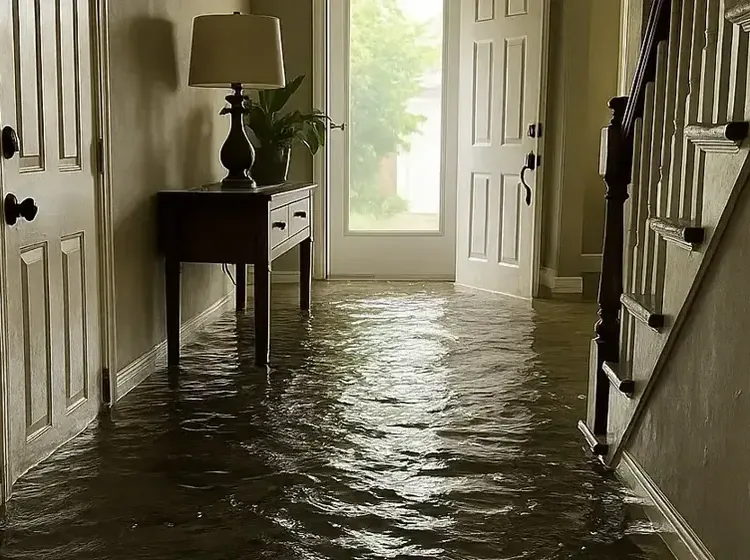
When a creek spills over its banks or a storm drain backs up, the water that reaches a house is not clean. In Spartanburg, where Lawsons Fork Creek has overflowed onto residential streets, that water is treated as contaminated from the first minute of cleanup.
Key takeaways
- Creek and storm drain water carries soil, debris and bacteria, so it is handled as contaminated flood water.
- NOAA's Storm Events Database records Lawsons Fork Creek overflowing onto Heathwood Drive and Lake Forest Drive, and the floodplain along the creek is described as not suitable for development.
- Storm drains are not filtered, so whatever flows into them reaches local waterways, and whatever backs out of them reaches the house.
- Porous materials that touched flood water, such as carpet pad and the lower drywall, are removed rather than dried.
- Insurance for flood is often separate from a standard homeowners policy, so ask the insurer early.
Why creek water is not clean water
A creek in flood carries soil, yard chemicals, fuel, animal waste and whatever else lies in its path. By the time it reaches a living room, it is treated as Category 3 water under IICRC S500.
That label decides the work: protective gear for the crew, removal of porous materials and disinfecting of surfaces that stay.
Even a few inches of flood water can make a house unsafe for people with asthma, open cuts or weak immune systems. That is a reason to keep the household out until the first stage of cleanup is done.
- Keep children and pets out of the water.
- Do not walk through flood water near outlets, cords or appliances.
- Do not run a household vacuum on wet floors.
- Photograph the water mark on the walls before it drops.
- Wear boots and gloves if wading is unavoidable, and wash up afterward.
- Throw away food that touched the water.
What the record shows for Lawsons Fork Creek
Lawson's Fork Creek is a tributary of the Pacolet River and lies entirely within Spartanburg County. NOAA's Storm Events Database records the creek overflowing onto Heathwood Drive and Lake Forest Drive, as well as onto at least one private drive.
The Cottonwood Trail in the Edwin M. Griffin Nature Preserve follows the creek just east of downtown, and the floodplain there is described as not suitable for development. The record does not give a date, so no year is attached to the event.
The National Weather Service office for Greenville-Spartanburg has also recalled a past flash flood in the county, mainly along Timms Creek and Lawson Fork Creek, that caused $2.5 million in damage.
Heavy rain tests the same ground again and again. A creek that has overflowed once can do so again, which is why homes beside a floodplain are worth watching during a storm.
Storm drains, Butterfly Creek and the debris problem
In 2023, five storm drain murals were painted along the Butterfly Creek Greenway in Northside to encourage residents to keep storm drains clean. A Keep OneSpartanburg Beautiful coordinator said that storm drains do not get filtered, so pollution and debris reach local waterways.
The same fact matters at home. A drain packed with leaves and trash sends water back up through low points, and the water that backs out of it is the same water that left the street.
- Leaves, litter and yard waste block the grate and slow the flow.
- Low driveways and garages are often the first places to take on water.
- A backed up drain can push water into a basement stairwell or garage floor drain.
First steps in a flooded house
Safety comes before cleanup. If water is touching outlets or the electrical panel, the power stays off until someone qualified has checked it.
Once it is safe to enter, the household can start documenting while the local team gets ready. Wide shots of each room, close shots of the water mark on the walls and a clear view of damaged appliances tell the insurer how deep the water stood.
- Shut off power to flooded areas at the breaker, from a dry spot.
- Move valuables, papers and photos to higher ground.
- Take wide and close photos of the water mark and damaged items.
- Open windows only if it is dry outside and safe to do so.

Extraction and removal of contaminated materials
The extraction crew pulls the water out first, since every extra hour in the house lets it soak further up the walls. Water extraction takes the standing water out of rooms and low spots.
Then the contaminated materials leave. Carpet and pad, lower drywall, insulation and soaked particleboard come out rather than being dried, since flood water leaves residue that drying cannot remove.
This is the core of storm and flood cleanup, and the surfaces that stay are cleaned and treated before they are dried.
Wet drywall is cut above the water mark and the cavity behind it is opened, since mud and moisture hide behind the board.
- Carpet and carpet pad that touched flood water.
- Drywall and insulation in the lower part of the walls.
- Particleboard, cardboard and soaked fabric furniture.
- Anything porous that cannot be cleaned and treated thoroughly.
Drying after the flood water leaves
Wall cavities, framing and subfloor stay wet long after the visible water is gone. Fans, dehumidifiers and moisture readings carry the drying through until the materials match a dry reference.
Because flood water is contaminated, the surfaces that remain, such as framing and concrete, are cleaned and treated before drying equipment goes to work. The same approach applies to any storm and flash flood cleanup across the region.
Wet wood and drywall also invite mold, so the equipment stays until the readings, not the surface, say the job is done.
Dehumidifiers bring the humidity in the house down while air movers drive moisture out of the framing, and a daily check shows whether the numbers are falling.
A long history of rain
Flooding is not new in the area. On June 6, 1903, heavy rain flooded the Pacolet River basin, and the Spartanburg gauge recorded 5 inches of rain in 24 hours.
Converse Mill on the Pacolet River was rebuilt that same year after a huge flood washed away the original mill.
In August 1908, heavy rain for 48 hours put Spartanburg County under water, with the record discharge on August 27, 1908. Spartanburg averages 51.3 inches of precipitation a year, spread fairly evenly through the seasons.
Questions
Is creek flood water considered contaminated?
Yes. It carries soil, debris and bacteria, so it is treated as Category 3 water and handled with protective gear and removal of porous materials.
Can wet carpet be saved after storm drain water?
Usually not. Carpet and pad that touched flood water are removed, because drying does not take out the contamination they absorb.
Why do storm drains matter to a homeowner?
They are not filtered, and a blocked drain can send water back up through low points. Keeping grates clear helps water leave the street.
What does the record say about Lawsons Fork Creek?
NOAA's Storm Events Database records the creek overflowing onto Heathwood Drive and Lake Forest Drive and at least one private drive. It does not provide a date.
Does homeowners insurance cover creek flooding?
Standard homeowners policies often exclude flood, which may be covered by a separate policy such as the National Flood Insurance Program. The policy itself decides, so ask the insurer early.