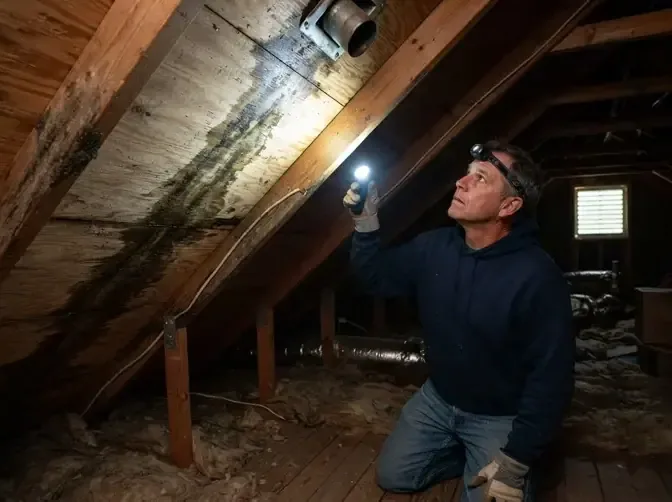
Wind does not need to tear off a roof to let water in. In Kings Mountain, where an EF2 tornado with winds of about 130 mph caused damage on February 6, 2020, a few lifted shingles can be enough to start a leak that shows up later as a ceiling stain.
Key takeaways
- A roof leak starts in the attic, so the stain on the ceiling often shows up long after the water first got in.
- Wind from the February 6, 2020 EF2 tornado and from Hurricane Helene on September 27, 2024 shows how storm wind can open a roof across Cleveland County.
- Wet attic insulation holds water against the ceiling and has to be removed, not left to dry in place.
- A bulging ceiling is holding water and can fall, so keep people out from under it.
- The roofer stops the leak and the drying team removes the water, and both jobs need a clear order and a record.
How wind opens a roof
Storm wind lifts shingle edges, loosens flashing around chimneys and vents, and tears at ridge caps. Rain driven sideways then slips under the opening and runs down the underlayment.
On February 6, 2020, an EF2 tornado with winds of about 130 mph caused damage in Cleveland County and Gaston County, including in Kings Mountain. The point is that wind of that force, or the strong wind that came with Hurricane Helene on September 27, 2024, can open a roof without removing it.
Helene also brought heavy rain, and it downed trees and knocked out power across Cleveland County. A limb on a roof can bruise shingles and leave a slow leak that nobody sees from the ground.
- Missing, curled or lifted shingles, or pieces of shingle in the yard.
- Bent or loose flashing around chimneys, vents and skylights.
- Exposed underlayment or nail heads along the ridge.
- Limbs or debris resting on the roof after a storm.
From lifted shingle to ceiling stain
Water that gets under the roof covering soaks the decking and drips into the attic. Insulation takes it up like a sponge and spreads it sideways across the ceiling below.
By the time a brown ring shows on the ceiling, the insulation above it has often been wet for some time. Ceiling stains often show up after storm days, which is why a leak can look new when it is not.
Insulation plays a part. A wet batt sags, presses against the drywall and carries water further along the ceiling, so a small opening in the roof can wet a large patch below.
Why the stain is not under the damage
Water runs along rafters, pipes and wires before it drops. A stain in a bedroom corner can sit well away from the lifted shingle that caused it.
That is why the roofer and the drying team both check the attic rather than the ceiling alone.
What to do when a stain appears
Speed helps, but safety comes first. A ceiling that is bulging or dripping is carrying a load of water, and it can come down without warning.
A bulge is trapped water, and opening it is a job for the crew, who can release it in a controlled way and catch it.
- Keep people and pets out from under any bulge or sag.
- Photograph the stain, then trace its edge with a pencil and date it to see whether it grows.
- Set a bucket under any drip and move furniture and rugs aside.
- Switch off ceiling lights and fans that are wet, and leave them off.
- Stay off a wet roof; a roofer can tarp it safely.
Tarp first, repair next
A roofer covers the opening and repairs the roof. The restoration team does not fix shingles, but it does remove the water that got in and dry what it soaked.
The split is the same for any roof leak, and the order matters. A tarp that goes on first keeps the next rain out while the drying work proceeds.
- Ask the roofer to photograph the damage before and after the tarp goes on.
- Keep receipts for tarping and any emergency repair.
- Share the roofer's findings with the drying team so the attic can be opened where it needs to be.
- Ask for the roofer's photos of the damage before the tarp covers the area; adjusters often ask for them.
Opening and drying the ceiling
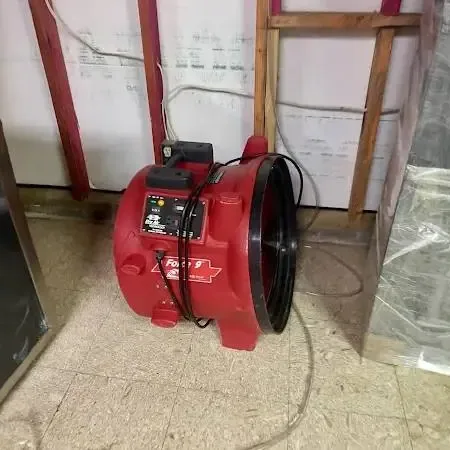
The crew starts by finding the wet area with a moisture meter and a thermal camera. The affected section of ceiling drywall is cut back to dry material so the joist bays above can be reached.
Wet insulation is removed and bagged, since it keeps water against the drywall and does not dry well in place. Fans and dehumidifiers then dry the joists, decking and the room below.
That is the core of ceiling leak water damage work, and the roof side of the same loss is covered under roof leak water damage.
- Ceiling drywall cut back to dry material and removed safely.
- Wet insulation bagged and taken out of the attic.
- Joists and decking dried with readings repeated until they match a dry reference.
- Walls below checked, since water runs down the cavity behind them.
Inspections and records after big storms
After Hurricane Helene, Cleveland County Building Inspections helped residents assess compromised buildings and damaged electrical equipment. That matters for a wet ceiling, which can hold light fixtures, fans and wiring.
A wet ceiling with electrical parts in it should be checked before anyone switches those parts back on.
Records help whatever the route. Dated photos, the roofer's report and the drying readings give an insurer a full picture of the loss from the first stain to the final dry reading.
- Dated photos of the roof, the attic and the ceiling.
- The roofer's findings and invoice.
- Daily moisture readings from the drying team.
- A list of damaged contents and finishes.
Watching for a repeat after the repair
After the roof is fixed and the ceiling is dry, the first heavy rain is the test. A stain that grows after a storm points to a leak the repair missed.
Catching it early keeps the second loss small.
- Check the ceiling and the attic after the first heavy rain.
- Look for damp insulation near the repaired area.
- Date the pencil mark on any old stain so growth is easy to see.
- Keep the roofer's work order handy in case the same spot leaks again.
Questions
Can a roof leak start without any visible damage from the ground?
Yes. Lifted shingles, bent flashing and small tears are hard to see from the yard, and the first sign is often a stain on the ceiling.
Why is the ceiling stain far from the damaged part of the roof?
Water runs along rafters, pipes and wires before it drops, so a stain can sit well away from the opening that let the water in.
Should a sagging ceiling be opened by the household?
A bulging ceiling is holding water and can fall. Keep people out from under it and let the crew open it in a controlled way.
Who repairs the roof and who dries the house?
A roofer covers and repairs the roof, and the restoration team removes the water and dries the attic, ceiling and walls.
What happens to wet attic insulation?
It is removed and bagged because it holds water against the ceiling and does not dry well in place.
How long before a roof leak shows on the ceiling?
It varies. Insulation can absorb water for a while before the drywall shows a stain, so a leak from an earlier storm can appear later.