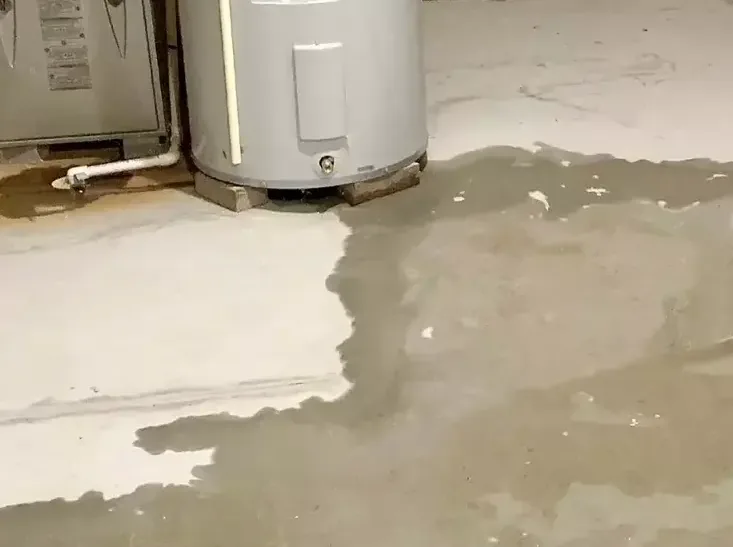
A tank water heater holds enough water to soak a closet, a garage corner or a crawl space before anyone finds a towel. In Gaffney, SC, the first steps are the same as anywhere: stop the supply, kill the power or gas, and get the standing water out before it reaches flooring and cabinets.
Key takeaways
- Close the cold water valve above the tank and switch off the breaker or gas control before touching anything wet.
- The tank's location decides the damage: a closet sends water into wall framing, a garage sends it across the slab, and a crawl space sends it into insulation and joists.
- A leaking tank is replaced, not patched, so the cleanup and the replacement have to be planned together.
- Extraction comes first, then drying of floors and wall cavities, with readings taken daily until framing and subfloor are within 2 to 4 points of a dry reference.
- Photos of the tank, its label and the wet areas, plus the drying readings, go into the insurance file.
Stop the water before anything else
A leaking tank keeps feeding itself for as long as the cold supply stays open. Closing that valve is the one step that limits how much water reaches the floor.
The valve sits on the pipe that enters the top of the tank and turns clockwise to close. If it will not turn, the main shutoff for the house does the same job.
- Close the cold water valve on the pipe above the tank, or the main shutoff if that valve is stuck.
- Switch off the breaker for an electric heater, and set the control to off on a gas heater.
- Stay out of standing water near outlets, cords and the heater's wiring.
- Take photos of the tank and the wet area before moving anything.
- Lift rugs, boxes and stored items out of the wet zone while the floor is still only damp.
Where the water goes depends on where the tank sits
Tank failures happen in closets, garages and crawl spaces, and each location sends water along a different path. Knowing the path tells the restoration team where to look for hidden moisture.
Closet and utility room
A closet tank is surrounded by drywall, so water follows the bottom plate into the wall and under the floor covering. A stain on a nearby baseboard is often the first visible sign.
Cabinets and shelving in the same space soak up water from the bottom and swell.
Garage
A garage slab lets water spread wide and thin, and it runs toward doors and drains. From there it wicks into the bottom of drywall and into boxes stacked along the walls.
Crawl space
A tank under the house leaks onto soil, insulation and the underside of the subfloor. Water can go unseen for a long time because nobody looks down there, which is why long leaks are the expensive ones.
What the extraction crew removes first
The extraction crew pulls standing water with truck-mounted and portable units, working from the lowest point of the room outward. The goal is to get the water out before it wicks into pad, subfloor and drywall, which is the core of water extraction.
Wet carpet pad and loose insulation come out next because they hold water against the subfloor. Baseboards often come off so the bottom of the wall can be opened and dried.
- Standing water extracted from floors and low spots.
- Carpet pad, loose insulation and soaked cardboard removed from the area.
- Baseboards and cabinet toe kicks pulled so wall bottoms can breathe.
- Hidden pockets checked with a moisture meter and thermal camera.
Drying floors, walls and cabinets
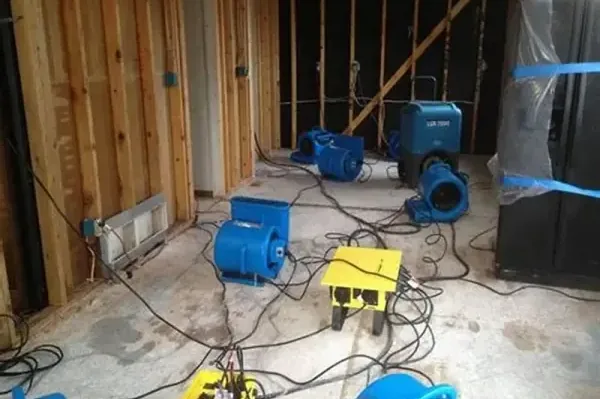
Once the puddles are gone, the work turns to what is still wet. Fans push dry air across surfaces while dehumidifiers pull moisture out of the room, and small openings let air reach wall cavities.
The drying team maps wet framing, subfloor and drywall with a moisture meter and repeats the readings every day. The target for framing, subfloor and sheathing is within 2 to 4 points of a dry reference, the benchmark set out in IICRC S500, and this is the heart of structural drying.
Wet drywall and wood that stay damp invite mold, which is why the equipment runs until the readings say the materials are dry rather than until they feel dry.
Replacing the tank and planning the order of work
A tank that leaks from the shell has reached the end of its life, so the fix is a replacement. The plumber needs a clear floor to work on, which is another reason to start extraction right away.
The order of work depends on the damage, and the restoration team and the plumber usually sort it out together.
- Ask the plumber to drain and remove the old tank as soon as it is safe.
- Photograph the label on the old tank for its age and model.
- Tell the restoration team where the old tank stood, since that spot is the wettest.
- Keep the drying equipment running until the readings are done, even after the new heater is in.
Photos, readings and the insurance file
An insurer wants to see the loss as it was, the cause and the steps taken. Photos taken before cleanup, a list of damaged items and the daily drying readings tell that story.
Policies differ, so the claim form and the adjuster decide what else is needed. A cost range can be sketched ahead of time with the water damage cost calculator.
- Wide shots of the room and close shots of the tank, the floor and any stains.
- A written list of damaged flooring, cabinets and stored items.
- The drying log from the restoration team.
- The plumber's invoice for the new heater.
Cleanup across the service area
The restoration team works in the Gaffney area and the ZIP codes 29340, 29341 and 29342 in Cherokee County, South Carolina.
A tank failure is one of several household sources that leave the same trace, and a washer hose or dishwasher connection can do the same job. That is the territory of appliance leak water damage, and the drying steps are the same.
Questions
Should the water heater be turned off when it leaks?
Yes. Close the cold water valve and shut off the power or gas first. An electric heater that stays on beside standing water is a shock risk, and a gas unit with a soaked floor around it should not keep running.
Can a leaking water heater tank be repaired?
A leak from the shell means the inner lining has failed, and patching does not hold. A leak at a fitting, valve or connection can sometimes be fixed by a plumber, so the source has to be found before the decision is made.
How far can the water from a tank travel?
A full tank holds a lot of water. In a closet it enters the wall framing, in a garage it spreads across the slab, and under the house it soaks insulation and the subfloor from below.
Is a small drip from the relief valve an emergency?
A drip is a warning rather than a flood, but it can mean the tank or its pressure is failing. Dry the area, set a bucket under it and have a plumber inspect the heater.
What does an insurance company usually want to see?
Photos taken before cleanup, the cause of the loss, the age of the tank if known, a list of damaged items and the daily drying readings. The claim form decides what else is required.
Does cleanup cost depend on where the tank sits?
Yes. A closet leak found early involves less drying than a tank under the house that leaked for a long time. The scope of work, not the size of the tank, sets the cost.