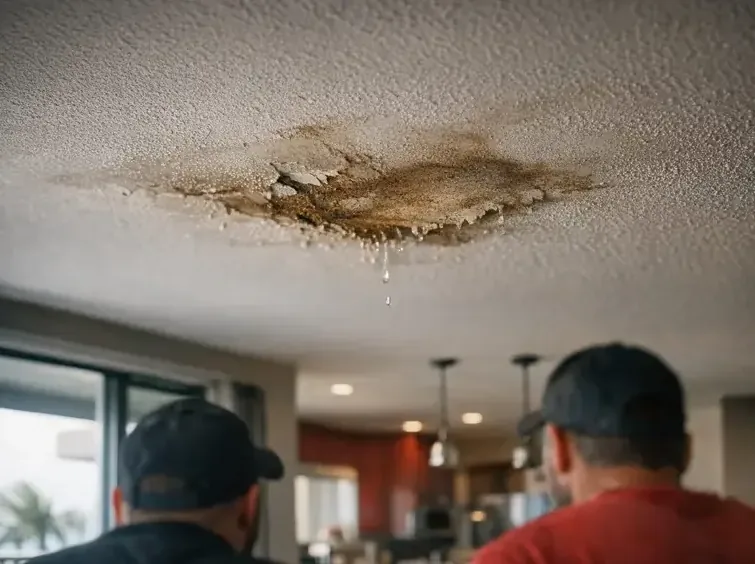
A manufactured home carries its plumbing, wiring and ductwork in a thin floor system, so a small leak reaches the structure fast. In Gaffney, SC, water under a manufactured home floor has to be pumped, opened up and dried from the belly wrap to the wall cavities.
Key takeaways
- A soft or spongy spot in the floor near a bath, kitchen or laundry usually means water has been present for a while.
- The floor deck is often particleboard, which swells and loses strength when it stays wet, so speed matters.
- Water can also hide inside the belly wrap, the material stretched under the floor that holds insulation and ducts.
- Drying has to cover the floor system and the wall cavities, because moisture wicks upward from the deck.
- Daily moisture readings, not a dry feel, decide when the equipment can come out.
Why a manufactured home floor reacts so fast
Most of the floor is a thin deck of particleboard laid over narrow framing. Particleboard is glued wood chips, and it swells and softens once water gets between the chips.
That is why manufactured home water damage is often a floor problem first. A small leak at a tub or a toilet can ruin a section of deck before a stain appears on the ceiling below, because there is no room below.
Weight adds to the problem. A wet deck that is walked on, loaded with furniture or crossed by a rolling cart can crack and compress, so soft spots are best kept clear of heavy traffic until the crew has looked at them.
Floor covering can also hide the damage. Vinyl and laminate trap moisture underneath, and a surface that looks fine may sit on a deck that has been wet for weeks.
- A soft or spongy spot in the floor, often near a tub, toilet, sink or washer.
- Floor covering that lifts, bubbles or separates at a seam.
- A musty smell that comes back after the room is aired out.
- Discolored paneling or baseboard along an outside wall.
- Doors and cabinets that start to stick.
Where the water comes from
Leaks, storms and plumbing failures all feed water into a manufactured home. The tricky part is that the source is rarely above the wet spot.
- Supply connections at tubs, sinks, toilets, the washer and the water heater closet.
- Drain pipes that loosen under the floor and drip into the belly.
- Roof, window and door leaks that run down walls to the floor edge.
- Rain driven under the home during a storm.
- A dishwasher or ice maker hose that seeps behind a cabinet.
The belly wrap and what hides inside it
The belly wrap is the material stretched across the underside of the floor framing. It keeps insulation and ducts in place and keeps animals out.
It also holds water. A leak above drips onto the insulation, and the wrap sags under the weight until it forms a pocket of trapped water.
Signs from the outside
A sagging patch in the underside, a drip from a seam or wet insulation hanging out of a tear all point to water inside the wrap.
Cutting the wrap to let the water out is a job for the crew, since the cut has to be placed so the water drains safely and the ducts and wires stay protected.
What a heavy belly holds
Insulation soaked with water weighs far more than dry insulation, and it pulls the wrap downward. A pocket that forms this way can hold a surprising amount of water, which then finds the nearest seam or tear.
If the wrap stays wet for a long time, the insulation inside can mat down, stay cold and keep wetting the underside of the deck from below.
Extraction and opening the floor
The extraction crew starts by pulling standing water from the floor surface with portable units. Under the home, an opening is cut in the wrap so the trapped water and wet insulation can be removed.
Swollen particleboard seldom returns to full strength, so sections that have lost their shape are cut out and replaced rather than dried and hoped for. Sound sections stay and are dried in place.
- Standing water extracted from the floor surface and from the belly pocket.
- Wet insulation removed from under the floor.
- Floor covering lifted and the deck checked for soft spots.
- Ducts and wiring inspected for water and damage before drying begins.
Drying the floor system and the wall cavities
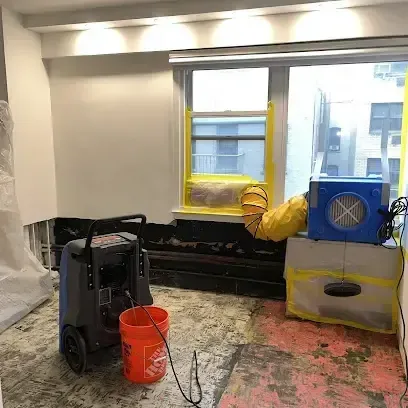
Moisture moves upward from the deck into the bottom of the walls, so drying a floor alone leaves the walls wet. Small holes at the base of wall panels let dry air move through the cavities.
The drying team places air movers and dehumidifiers and takes moisture readings from the deck, the framing and the wall bottoms every day. That is the routine behind structural drying, and a rough schedule can be sketched with the drying time estimator.
Air has to move under the home as well as inside it. With the wrap open, fans can push air across the underside of the deck while dehumidifiers work inside, so the floor dries from both faces at once.
Closing the belly and finishing the floor
Once the readings reach the dry standard, the plumber fixes the source, new insulation goes in and the wrap is closed. Replaced deck sections get new floor covering to match the rest of the room.
The fix comes before the finish. Closing a floor over a leak that still drips only repeats the loss.
What to document for the claim
An insurer wants proof of what was wet and why. Photos taken before anything is cut, opened or removed give the adjuster a clear picture of the loss as it started.
The drying log, with readings from the deck and the wall bottoms, shows that the job reached the dry standard.
- Photos of soft spots, stains and the underside of the home before any cutting.
- A note of when the problem was first noticed and what was done about it.
- The plumber's invoice for the repair of the source.
- The daily drying readings from the restoration team.
Questions
Does a manufactured home dry the same way as a site-built home?
The principles are the same, but the floor system is thinner and the belly wrap can trap water. The crew has to open the underside as well as treat the surface.
Can a particleboard floor be saved after it gets wet?
Light, short exposure can dry in place. Deck that has swollen, crumbled or gone spongy usually has to be cut out and replaced.
How can a household tell if water is in the belly?
Look for a sag in the underside, drips from seams and wet insulation. A soft spot in the floor above is another clue.
Should the belly wrap be cut open without help?
No. The cut has to be placed so the water drains safely and so ducts and wires are not damaged.
Where do leaks usually start in a manufactured home?
Around tubs, toilets, sinks, the washer and the water heater closet, where supply and drain connections sit close to the floor.
What tells the crew that the floor is dry?
Moisture readings from the deck, the framing and the wall bottoms, taken on each visit and compared with a dry reference.